
Art for When the Reframe Is Actually a New Frame
Liste and Art Basel selections, and an evangelical case for elevating all the frames in the home, studio, and gallery

Good morning contemporary art fans! While I am very excited to share this week’s selections, which are mostly sourced from Liste and Art Basel previews, if you can believe it I am actually even more excited to share insights into framing STAY WITH ME THIS WILL CHANGE YOUR LIFE ART COLLECTION.
There are myriad of aspects that change how art is installed and subsequently lived with: the install height; the lighting; the wall color; the other pieces in the room. But my absolute favorite and arguably the most impactful choice you will make after acquisition is how you frame the art.
I am witness to how the right frame enhances the glow of an artwork: for my client’s Maggie Ellis work on paper, I did not originally envision a 4-inch mat around the work and I always preach about white frames. But I trusted the pros at DDG Frame Shop who suggested the wider mat and this beautiful walnut frame, and the client and I could not be more impressed with the final result:

Framing is definitely one of those opaque parts of the art world, where after you acquire a work and you’re already gutted sending that wire to pay for it, you receive another punch to the stomach when you see the framing estimate. I PROMISE STAYING WITH ME IS WORTH IT.
So today we are lifting the veil on why it costs so much, why it is worth it, and how you can get preferred framing prices this summer (told you it would be worth it, discounts RARELY happen in the frame world). Whether you are a private collector, a gallerist, or an artist with works in the studio in need of frames, you will appreciate how this post will change your art.
OK the first way to tell if you need to upgrade your framing is if you can see the seams in the corners: this means it is a chop frame, where the frame is cut at a 45 degree angle, then glued and nailed together. Ugh. A properly framed work sells faster. Elevate the piece and watch how quickly it moves.
What you actually need is a closed corner finished frame, spline joined with a finish applied. This creates seamless corners that hold over time with no visible ugly seam in the corners that is probably getting worse if your home’s temperature fluctuates and the frame starts to split apart. Below is a closeup of an exemplary frame:
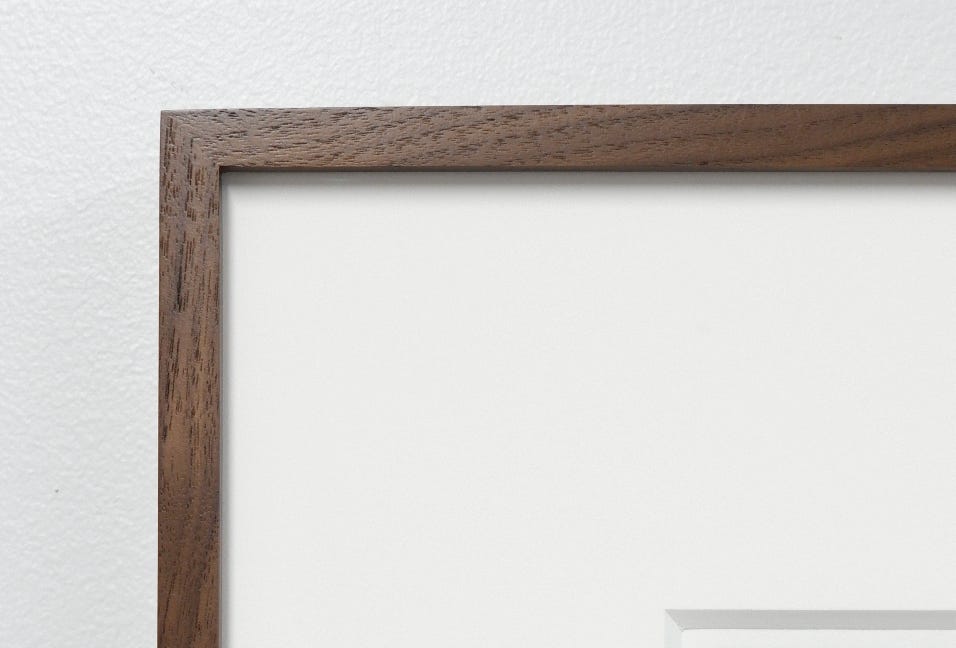
Now that you have seen this prime example, I’m sorry that you will never be able to unsee a bad frame job
I spoke with DDG Frame Shop, established in 1988, about their five rules for museum quality framing. Turns out that it’s not just about shaping a piece of wood around the art: this is about protecting and conserving your investment.
1. Let the Art Speak First. The frame should support the artist’s vision, not compete with it! Restraint is usually the right call in contemporary art. The goal is presentation, not decoration.
2. Only Do What Can Be Undone. Conservation framing prioritizes reversibility. Japanese paper hinges and cotton rag corners allow the artwork to be safely removed later without damage. The artwork also needs room to expand and contract naturally!
3. Use 100% Cotton Rag Matboard. Cotton rag is naturally stable, won’t yellow, and has a long preservation track record. Most budget matboards are wood pulp, which degrades over time. Since matboard is usually the only material in direct contact with the artwork, the quality of that material matters enormously.
4. Always Use UV Protective Glazing. Light damage is cumulative and irreversible. Museum-grade glazing blocks at least 90% of UV light. The industry standard is Optium Acrylic, which adds anti-reflective and abrasion-resistant coating on top of UV protection. Yes, I am aware that choosing UV museum-grade is the more expensive option! However we are investing in our investments, people, so if you’re already spending the money on a beautiful frame, you should spend the money on the better glazing. The adage “Buy the best, and you only cry once” exists for a reason, and I can’t really talk about how many times I’ve paid to reframe crummy frames.
5. Never Let Artwork Touch the Glass. Moisture and environmental shifts can cause the artwork to permanently adhere to the glazing. A mat or spacer must always create separation between the artwork and the glazing surface.
This is not a sponsored post, I just genuinely love DDG Frame Shop! I have sent my clients there and I asked if they’d extend a rate to my subscribers because I think everyone reading this newsletter should know they exist.
THANKS FOR STICKING WITH ME! Your reward is access to the best frame shop I have ever worked with in my 10+ years in the New York art world.
Heather at DDG Frame Shop is extending 10% off to readers of this newsletter through July 31. Just mention where you found her: heather@ddgframeshop.com.
Additionally, if you are in the New York metro area, DDG Frame Shop can come to you for complimentary in-home consultation, pickup, and drop-off.
Lastly, I leave you with these pro tips:
Framing takes several weeks: adjust your timing expectations, especially if you are a gallerist with an upcoming exhibition.
Use DDG’s cheat sheet for 101 framing terminology. You will definitely want to save this for future reference.
Defer to the framer on suggested hardware: wire, D-rings, cleats. You do not want the hardware to be visible, and I think a cleat looks better because it lets the piece sit flush against the wall.
Do not admit to your partner how much framing costs (at all costs).
Enjoy the week’s selections!
